
If you are considering replacing old storage heaters or changing the way you heat your home, this electric heating cost comparison is a useful starting point. It is worth looking beyond the price of the heater itself.
Your heating costs depend on several things: how much heat your home needs, the electricity tariff you use, the temperature you choose, how well the property retains heat and how effectively you can control the heating.
Modern German electric heating can give you much greater control over when and where heat is used. For many homes, that can make a significant difference to both comfort and electricity consumption.
This guide explains the main factors affecting electric heating costs and compares traditional storage heating with modern German electric heating using real-world examples and clearly stated assumptions.
What determines your heating costs?
The amount you spend on heating is not determined simply by the wattage printed on a heater.
The main factors are:
- The size and construction of your home
- Insulation and heat loss
- The temperature you want to maintain
- How many hours each room is heated
- The size and power of the heaters
- How accurately the heating is controlled
- Your electricity tariff
- When electricity is being used
This is why two similar-looking homes can have quite different heating bills.
A correctly sized heater with an accurate thermostat can switch on when heat is required and switch off when the room reaches the chosen temperature. You are therefore not necessarily using the heater’s full rated power for the entire time it is switched on.
Our electric heating calculator uses room measurements to help establish the appropriate heater size for each room.
Electric Heating Cost Comparison for a Typical 3-Bedroom Home
One of our previous cost comparisons looked at a typical UK three-bedroom home with an assumed annual heating requirement of approximately 16,000 kWh.
The figures below are an example rather than a prediction of what any particular home will cost.
| Heating system | Example annual cost | Main tariff assumption |
|---|---|---|
| Infrared panels | £1,400–£1,800 | Standard electricity |
| Gas boiler | £1,600–£1,800 | Mains gas |
| German electric radiators | £1,700–£1,900 | Standard electricity |
| Traditional storage heating | £2,300–£2,600 | Economy 7 |
These figures were based on historical assumptions and should not be treated as current quotations. Energy prices and tariffs change, and actual costs can be substantially different from one property to another.
The useful point is not that one heating system will always be cheaper than another.
The useful point is that the way your home is heated and the tariff you use can make a considerable difference to your overall cost.
Storage heaters compared with modern German electric heating
Traditional storage heaters were designed around cheaper overnight electricity.
They store heat during the charging period and release it later. This can work well where the heating pattern matches the charging period.
The difficulty is that modern lifestyles are not always predictable.
You may want your heating:
- Earlier in the morning
- Later in the evening
- In one room but not another
- For a short period during the day
- At different temperatures in different rooms
Modern German electric heaters work differently.
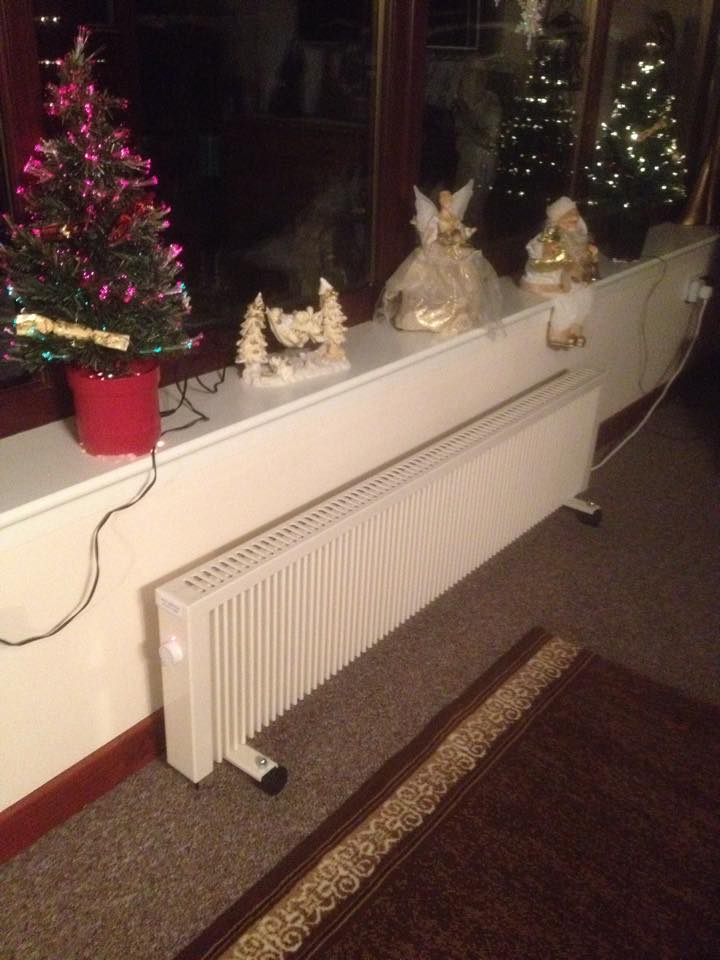
They are direct electric heaters with a thermal mass, such as a ceramic or clay core, combined with modern thermostatic control.
Instead of charging a large storage heater overnight and relying on the heat being available later, you can control each room according to when you actually need it.
That can provide a much more flexible heating system.
Why control matters
Good heating control is one of the biggest advantages of modern electric heating.
An accurate thermostat can monitor the room temperature and regulate the heater automatically.
For example, if a room reaches the temperature you have selected, the heater does not need to continue operating continuously at its full rated power.
This is one reason why the electrical rating of a heater should not be confused with its actual electricity consumption.
A 2kW heater does not necessarily consume 2kWh every hour that it is switched on.
Its actual consumption depends on how often it needs to operate to maintain the required temperature.
This is also why choosing the correct heater size for the room is important.
Our article about lower-powered electric heaters explains this in more detail.
Historical electricity tariff example
Tariffs can have a major effect on the cost of electric heating.
For example, an earlier comparison used OVO tariff figures from April 2025.
| Tariff | Electricity rate |
|---|---|
| Standard electricity | 25.70p/kWh |
| THTC heating | 22.71p/kWh |
| Difference | 2.99p/kWh |
The same tariff information showed that electricity used outside the heating allocation could have a different rate.
These figures are included to demonstrate the principle rather than to suggest that they are today’s prices.
Electricity tariffs change regularly, and the tariff available to you may depend on your location, meter, supplier and type of heating system.
For current information, it is sensible to check the latest published tariff information rather than relying on an old comparison.
A historical worked example
Another comparison previously published by Elsco used the following example:
| Example | Heater rating | Operating period | Historical cost |
|---|---|---|---|
| Storage heater | 3.4kW | 8 hours | £6.18 |
| German clay-core heater | 2.0kW | 16 hours | £2.73 |
This historical example shows a significant running-cost saving under the stated conditions. At the example tariffs, the storage heater figure corresponds to a full eight-hour charge. The clay-core radiator figure corresponds to about 20 minutes of active heating per hour across a 16-hour schedule, or roughly 5 hours and 20 minutes of electricity use at full power. The saving in your home will depend on your tariff, how much your old storage heater typically charges, and how long a correctly sized replacement needs to run to keep the room equally comfortable.
Economy 7 versus single-rate electricity: Northern Scotland, October 2026
As a separate example, Ecotricity’s Northern Scotland variable prepayment tariff sheet, effective 1 October 2026, lists 18.73p/kWh overnight and 28.10p/kWh during the day on Economy 7, and 25.54p/kWh on its single-rate tariff. The night rate is 6.81p/kWh below the single rate. These are one supplier’s rates for one region and payment method.
| Heating example | Electricity used | Unit rate | Energy cost for the day |
|---|---|---|---|
| Old 3.4 kW storage heater taking a full seven-hour Economy 7 charge | 23.8 kWh | 18.73p/kWh | £4.46 |
| 2.0 kW clay-core radiator averaging 20 minutes on per hour over 16 hours | 10.67 kWh | 25.54p/kWh | £2.72 |
The clay-core example costs about £1.73 less per day using the unrounded figures, provided both heaters keep the room comparably comfortable. The costs are roughly equal if the storage heater charges with about 14.5 kWh instead of taking a full charge. The radiator’s runtime is an illustrative assumption. The table covers heater electricity only. For a tariff decision, compare standing charges, daytime electricity, hot water and any top-up heating.
A smaller off-peak discount reduces the running-cost advantage of buying electricity overnight. The tariff changes the price paid per unit. The amount of heat needed and how much of the stored heat is released when the room needs it affect the energy the household uses.
For a side-by-side look at suppliers’ Economy 7 day and night rates, standing charges and a worked room-heating example, read the comparison of old storage heaters, German clay-core radiators and infrared panels.
The important lesson is that heater rating, operating time and electricity tariff all interact.
A heater that operates at a lower average power for longer can sometimes provide the required comfort without consuming as much electricity as a larger heater operating for a shorter period.
Correct sizing is therefore extremely important.
A real-world customer example
We also have an individual real-world example from a retired chartered engineer who replaced storage heating with Elsco German clay-core heaters.
He kept careful records of his heating costs and reported approximately a 33% reduction in recorded heating costs, together with improved comfort.
That is useful evidence from an actual installation, but it is still one person’s experience.
It should not be interpreted as a guaranteed 33% saving for every home.
The result in any property will depend on its construction, insulation, heating requirements, tariff, thermostat settings and how the heating is used.
Could German electric heating reduce your heating costs?
It can.
But the reason is not that ceramic or clay somehow creates more heat from each unit of electricity.
The potential advantage comes from having a heating system that allows you to manage your heat more effectively.
You can heat individual rooms when required, maintain comfortable temperatures with thermostatic control and avoid heating areas unnecessarily.
In some homes, replacing older storage heaters can also allow a lower-powered heating system to provide the required comfort.
That is why we recommend sizing the heating for the individual rooms rather than simply replacing one old heater with another of the same electrical rating.
Comfort is part of the calculation
Heating costs should not be considered in isolation.
A system that costs less but leaves you uncomfortable is not necessarily a satisfactory heating solution.
Many people replacing storage heaters tell us that they value the ability to control the temperature more precisely and have heat available when they actually need it.
Modern German electric heating can provide:
- Room-by-room temperature control
- Fast response when heat is required
- Accurate thermostatic regulation
- Quiet operation
- A slim wall-mounted design
- Consistent background warmth
- Flexible heating schedules
For many households, the improvement in control and comfort is just as important as the potential reduction in electricity consumption.
When might modern German electric heating not be the answer?
No heating system is automatically right for every property.
If a home has very high heat loss, poor insulation or unusually high heating requirements, those issues should be considered before changing the heating system.
Likewise, the cheapest tariff on paper is not necessarily the best tariff for every household.
The important thing is to look at the property, how you use the rooms and how your electricity tariff works.
How much could your heating cost?
The best way to get a useful estimate is to start with your own rooms rather than a national average.
Our electric heating calculator uses room measurements to help determine suitable heater sizes and provides an instant quotation.
Because room height affects the volume of air being heated, our calculator uses room volume rather than simply looking at floor area.
That gives us a better starting point for selecting the appropriate heater power.
Independent information and heating-cost comparisons
Heating-cost comparisons are only useful when their assumptions are understood.
The Sutherland Tables have long been used as an independent source for comparing the costs of different heating systems and fuels. Their figures are updated regularly because energy prices and tariffs change.
Ofgem has also used Sutherland Tables in published analysis when comparing heating costs.
This is why an old cost comparison should never be presented as though it were a current energy bill.
The principle of comparing heating systems remains useful, but the actual tariff rates need to be dated.
The important question is not simply “Which heater is cheapest?”
A better question is:
Which heating system gives my home the comfort and control I need at a reasonable overall cost?
For someone replacing old storage heaters, modern German electric heating can offer a very different way of managing heat.
Instead of planning your day around when a storage heater charged, you can control individual rooms and heat them when they are needed.
That combination of correct sizing, accurate thermostatic control and flexible room-by-room heating is where the potential cost benefit comes from.
Find out what your own home needs
Every house is different.
If you are thinking about replacing storage heaters, changing from another form of electric heating or simply want to see what German electric heating would cost for your home, start with the room measurements.
Use our electric heating calculator to calculate suitable heater sizes and see your quotation.
You can also learn more about:
- German electric heaters
- Storage heater replacement in Scotland
- Electric heater controls
- Lower-powered electric heaters
Elsco Heating supplies and installs modern German electric heating across Scotland, with advice based on the property, the rooms being heated and the way you actually use your home.
Frequently asked questions
Are German electric heaters cheaper to run than storage heaters?
They can be in some homes, but there is no universal saving figure. Costs depend on the property, heater sizing, thermostat settings, tariff and how the heating is used.
Do German electric heaters use less electricity?
A correctly sized, thermostatically controlled heater may use less electricity because it only needs to operate when heat is required. However, ceramic or clay-core construction does not create additional heat from electricity.
Are storage heaters still economical?
They can be, particularly where a suitable off-peak tariff is available and the household’s heating pattern matches the storage period. Modern heating provides greater flexibility when heat is required at different times.
Does a 2kW heater use 2kWh every hour?
Not necessarily. A 2kW heater can consume up to 2kWh if operating continuously for one hour, but thermostatic control can switch the heater on and off as the room reaches and falls below the selected temperature.
Why does heater size matter?
A heater needs to be capable of meeting the heat loss from the room. Oversizing does not automatically reduce running costs, while undersizing can leave a room struggling to reach the required temperature.
Can I replace a storage heater with a lower-powered German heater?
In some situations, yes. Heater size should be calculated from the room and its heat-loss requirements rather than simply matching the old heater’s rating.
How can I calculate the right heater size?
Use the Elsco electric heating calculator and enter the measurements for each room. The calculator uses room volume as part of the sizing process.
Will electricity prices change the comparison?
Yes. Electricity tariffs can change significantly, so historical cost comparisons should always be dated. The same heating system can have a different running cost under a different tariff.
For help comparing single-rate and off-peak electricity, read our electric heating running costs and tariffs guide. Compare the whole household bill, including hot water and electricity used outside heating periods.
Is German electric heating suitable for every home?
Not automatically. The property’s insulation, heat loss, room use and existing heating arrangements all need to be considered. For many homes replacing older storage heaters, however, modern German electric heating can provide a practical combination of comfort, control and flexibility.